Autumn Flags
Autumn (also fall in North American English) is one of the four temperate seasons, the transition from summer into winter. more...
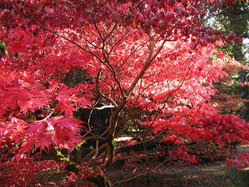
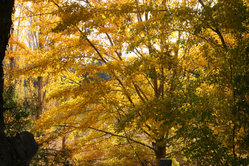
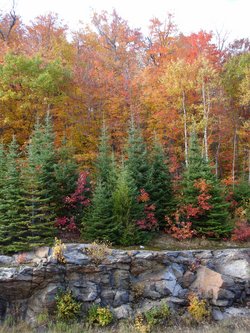
In the temperate zones, autumn is the season during which most crops are harvested, and deciduous trees lose their leaves. It is also the season in which the days rapidly get shorter and cooler (especially in the northern latitudes), and of gradually increasing precipitation in some parts of the world.
Astronomically, it begins with the autumnal equinox (around September 23 in the Northern hemisphere, and March 21 in the southern hemisphere), and ends with the winter solstice (around December 21 in the Northern hemisphere and June 21 in the Southern hemisphere). However, meteorologists count the entire months of March, April and May in the Southern hemisphere, and September, October and November in the Northern hemisphere as autumn. An exception to these definitions is found in the Irish Calendar which still follows the Celtic cycle, where Autumn is counted as the whole months of August, September and October.
Although the days begin to shorten in July or August in the northern latitudes and in January and February in the south, it is usually in September or March where twilight becomes evidently shorter and more abrupt in comparison with the more lingering ones of summer.
Autumn is often defined as the start of the school year in most countries, since they usually begin in early September or early March (depending on the latitude).
Either definition, as with those of the seasons generally, is flawed because it assumes that the seasons are all of the same length, and begin and end at the same time throughout the temperate zone of each hemisphere.
Autumn in popular culture
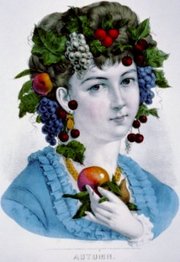
Autumn's association with the transition from warm to cold weather in the northern hemisphere, and its related status as the season of the primary harvest, has dominated its themes and popular images. In Western cultures, personifications of Autumn are usually pretty, well-fed females decked out with fruits, vegetables and grains that ripen at this time. Most ancient cultures featured autumnal celebrations of the harvest, often the most important on their calendars. Still extant echoes of these celebrations are found in the late-Autumn Thanksgiving holiday of the United States, the Jewish Sukkot holiday with its roots as a full moon harvest festival of "tabernacles" (huts wherein the harvest was processed and which later gained religious significance), the many North American Indian festivals tied to harvest of autumnally ripe foods gathered in the wild, the Chinese Mid-Autumn or Moon festival, and many others. The predominant mood of these autumnal celebrations is a gladness for the fruits of the earth mixed with a certain melancholy linked to the imminence of harsh weather. Remembrance of ancestors is also a common theme.
Read more at Wikipedia.org



 Contact
 Home
Home Benches
 American Flags
 Autumn Flags