Fountains
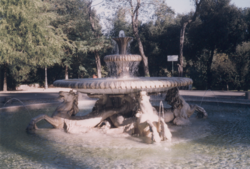
A traditional fountain is an arrangement where water issues from a source (Latin fons), fills a basin of some kind, and is drained away. Fountains may be wall fountains or free-standing. In fountains sheets of water may flow over varied surfaces of stone, concrete or metal. more...
Basins may overflow from one into another, or the overflow may imitate a natural cascade. Many fountains are located in small, artificial, ornamental ponds, basins and formal garden pools, and often they include sculpture.
One of the most common features of a fountain, if there is enough pressure, is a jet or multiple jets, where water is forced into the air under pressure to some height. A famous example of such a modern fountain rises from the surface of Lake Geneva.
History
Early fountains depended on the natural gravitational flow of water, from a spring or aqueduct supplied by a distant and higher source of water, which provided hydraulic head.
Hellenistic hydraulic engineers employed great originality in designing fountains, where the water pressure might be employed to animate automata and water organs.
Other early fountains were geometrically regularized springs, developed in the classic Persian garden. These gardens were typically enclosed and were designed to provide relaxation. The effect of sunlight was the main concern regarding the structural aspect of the Persian garden design. Shapes and textures were specifically chosen in the design of the Persian garden for their ability to direct sunlight. In the 16th century elaborate fountain displays were garden features of Mannerist gardens of Central Italy and the Mughal gardens of India.
Early Modern English employed fountain to refer to a natural spring water or source, which the 16th century garden fountain might consciously imitate in a grotto.
Fountain of life
-
Christian allegory made much use of the concept of the fountain, specifically the Fountain of Life, associated with the rebirth that was intended to be experienced at the Baptismal font. The Fountain of Life appears in Christian illuminated manuscripts of Late Antiquity, and elaborate Gothic fountains formed centerpieces for exclosed gardens. An offshoot of the Fountain of Life was the legend of the Fountain of Youth, which Juan Ponce de León sought in Florida. From the Fountain of Youth one can drink to gain immortality, or to regain one's youth.
The practical Romans marked the delivery end of aqueducts with a public fountain, a practice that was revived in Rome in the 15th century, when the restored Aqua Felice once more delivered a symbolic presentation of its waters to Rome in the original Trevi Fountain, since replaced by the familiar Baroque fusion of water, architecture and sculpture.
Read more at Wikipedia.org







 Contact
 Home
Home Flags & Flagpoles
 Fountains
 Garden Fountain