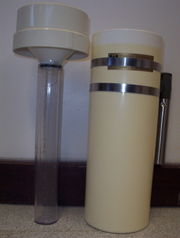
A rain gauge (also known as an udometer or a pluviometer or a cup) is a type of instrument used by meteorologists and hydrologists to gather and measure the amount of liquid precipitation (as opposed to solid precipitation that is measured by a snow gauge) over a set period of time.
Most rain gauges generally measure the precipitation in millimeters. The level of rainfall is sometimes reported as inches or centimeters.
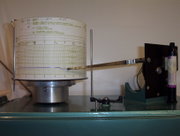
Types of rain gauges include graduated cylinders, weighing gauges, tipping bucket gauges, and simple buried pit collectors. Each type has its advantages and disadvantages for collecting rain data.
Rain gauges have their limitations. Attempting to collect rain data in a hurricane can be nearly impossible and unreliable (even if the equipment survives) due to wind extremes. Also, rain gauges only indicate rainfall in a localized area. For virtually any gauge, drops will stick to the sides or funnel of the collecting device, such that amounts are very slightly underestimated, and those of .01 inches or .02 mm may be recorded as a trace.
Another problem encountered is when the temperature is close to or below freezing. Rain may fall on the funnel and freeze or snow may collect in the gauge and not permit any subsequent rain to pass through.
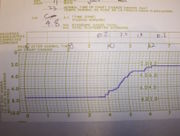
Rain gauge amounts are read either manually or by AWS (Automatic Weather Station). The frequency of readings will depend on the requirements of the collection agency. Some countries will supplement the paid weather observer with a network of volunteers to obtain precipitation data (and other types of weather) for sparsely populated areas.
In most cases the precipitation is not retained, however some stations do submit rainfall (and snowfall) for testing, which is done to obtain levels of pollutants.
Rain gauges, like most meteorological instruments, should be placed far enough away from structures and trees to ensure that any effects caused are minimised.
History
The first known records of rainfalls were kept by the Ancient Greeks about 500 B.C. This was followed 100 years later by people in India using bowls to record the rainfall. The readings from these were correlated against expected growth, and used as a basis for land taxes. In the Arthashastra, used for example in Magadha, precise standards were set as to grain production. Each of the state storehouses were equipped with a standardised rain gauge to classify land for taxation purposes.
Some sources state that the Cheugugi of Korea was the world's first gauge, while other sources say that Jang Yeong Sil developed or refined an existing gauge.
Read more at Wikipedia.org



 Contact
 Home
Home Flags & Flagpoles
 Rain Gauge