Plants, Seeds & Bulbs
Fennel (Foeniculum vulgare) is a plant species in the genus Foeniculum (treated as the sole species in the genus by most botanists). more...
It is a hardy, perennial, umbelliferous herb, with yellow flowers and feathery leaves, grows wild in most parts of temperate Europe, but is generally considered indigenous to the shores of the Mediterranean, whence it spreads eastwards to India. It has followed civilization, especially where Romans have colonized, and may be found growing wild in many parts of the world upon dry soils near the sea-coast and upon river-banks. It is a member of the family Apiaceae. It is a highly aromatic and flavorful herb with culinary and medicinal uses, and is one of the primary ingredients of absinthe. Fennel is used as a food plant by the larvae of some Lepidoptera species including the Mouse Moth and the Anise Swallowtail.
Appearance
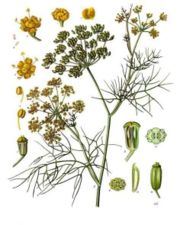
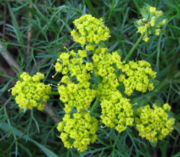
Fennel is a perennial herb, meaning that it grows year-round. It is erect, glaucous green, and grows to heights of up to 2.5 m, with hollow stems. The leaves grow up to 40 cm long; they are finely dissected, with the ultimate segments filiform, about 0.5 mm wide. Its leaves are similar to those of dill, but thinner. The flowers are produced in terminal compound umbels 5–15 cm wide, each umbel section having 20–50 tiny yellow flowers on short pedicels. The fruit is a dry seed from 4–10 mm long, half as wide or less, and grooved.
Cultivation and uses
Fennel is widely cultivated, both in its native range and elsewhere, for its edible, strongly-flavoured leaves and seeds. The flavour is similar to that of anise and star anise, though usually not as strong.
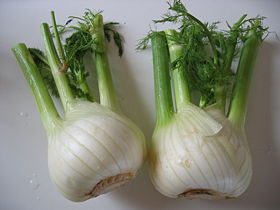
The Florence fennel (Foeniculum vulgare Azoricum Group; syn. F. vulgare var. azoricum) is a Cultivar Group with inflated leaf bases which form a bulb-like structure. It is of cultivated origin, and has a mild anise-like flavour, but is more aromatic and sweeter. Its flavour comes from anethole, an aromatic compound also found in anise and star anise. Florence fennel plants are smaller than the wild type and have inflated leaf bases which are eaten as a vegetable, both raw and cooked. There are several cultivars of Florence fennel, which is also known by several other names, notably the Italian name finocchio. In North American supermarkets, it is often mislabelled as "anise".
Fennel has become naturalised along roadsides, in pastures, and in other open sites in many regions, including northern Europe, the United States, southern Canada and in much of Asia and Australia. It propagates well by seed, and is considered an invasive species and a weed in Australia and the United States (see Santa Cruz Island).
Read more at Wikipedia.org




 Contact
 Home
Home Children's Gardening Items
 Aquatic Plants
 Plants