Water Hyacinth
The seven species of water hyacinths comprise the genus Eichhornia of free-floating perennial aquatic plants native to tropical South America. With broad, thick and glossy ovate leaves, water hyacinths may rise some 1 metre in height. more...
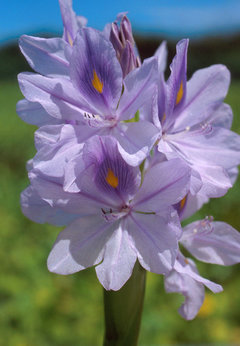
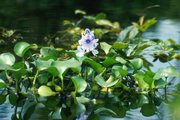
The leaves are 10-20 cm across, supported above the water surface by long, spongy and bulbous stalks. The feathery, freely hanging roots are purplish black. An erect stalk supports a single spike of 8-15 conspicuously attractive flowers, mostly lavender to pinkish in colour with six petals. When not in bloom, water hyacinth may be mistaken for frog's-bit (Limnobium spongia).
One of the fastest growing plants known, water hyacinth reproduces primarily by way of runners or stolons, eventually forming daughter plants. They may also reproduce via seeds. The common water hyacinth (Eichhornia crassipes) is a vigorous grower known to double its population in two weeks.
Water Hyacinth as an invasive exotic plant
Water Hyacinths have been widely introduced throughout North America, Asia, Australia and Africa. In many areas they, particularly E. crassipes, are important and pernicious invasive species. First introduced to North America in 1884, an estimated 50 kilograms per square metre of hyacinth once choked Florida's waterways, although the problem there has since been mitigated. When not controlled, water hyacinth will cover lakes and ponds entirely; this dramatically impacts water flow, blocks sunlight from reaching native aquatic plants, and starves the water of oxygen.
Directly blamed for starving subsistence farmers in Papua New Guinea and Australia, water hyacinth remains a major problem where effective control programmes are not in place. In some areas, the plants are however more valued, being harvested for cattle food. The plants also create a prime habitat for mosquitos, the classic vectors of disease, and a species of snail known to host a parasitic flatworm which causes schistosomiasis (snail fever).
As chemical and mechanical removal is often too expensive and ineffective, researchers have turned to biological control agents to deal with water hyacinth. The effort began in the 1970s when USDA resarchers released three species of weevil known to feed on water hyacinth into the United States, Neochetina bruchi, N. eichhorniae, and the water hyacinth borer Sameodes albiguttalis. Although meeting with limited success, the weevils have since been released in more than 20 other countries.
Read more at Wikipedia.org



 Contact
 Home
Home Aquatic Plants
 Plants, Seedlings
 Bog
Bog