Bog
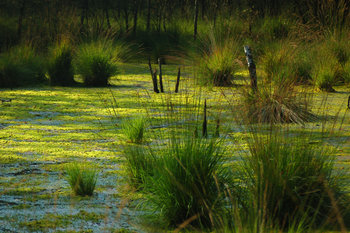
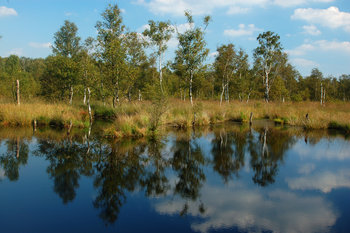
A bog is a wetland type that accumulates acidic peat, a deposit of dead plant material. more...
The term peat bog in common usage is not entirely redundant, although it would be proper to call these sphagnum bogs if the peat is composed mostly of acidophilic moss (peat moss or Sphagnum spp.). Lichens are a principal component of peat in the far north. Moisture is provided entirely by precipitation and for this reason bog waters are acidic and termed ombrotrophic (or cloud-fed) which accounts for their low plant nutrient status. Excess rainfall outflows giving bog waters a distinctive tan colour.
Bogs are widely distributed in cold, temperate climates, mostly in the northern hemisphere (Boreal). The world's largest wetlands are the bogs of the Western Siberian Lowlands in Russia which cover more than 600,000 square kilometres. Sphagnum bogs were widespread in northern Europe. Ireland was more than 15 per cent bog; Achill Island off Ireland is 87 per cent bog. There are extensive bogs in Canada (called muskegs), Scotland, Denmark, Estonia, Finland, and northern Germany. There are also bogs in the Falkland Islands. Ombrotrophic wetlands - i.e. bogs are also found in the tropics with notable areas documented in Kalimantan. These habitats are forested. Extensive bogs cover the northern areas of the U.S. states of Minnesota and Michigan, most notably on Isle Royale in Lake Superior.
World's largest wetlands
The world's largest wetlands are the bogs of the Western Siberian Lowlands in Russia which cover more than 600,000 square kilometres.
"The world's largest frozen peat bog is melting. An area stretching for a million square kilometres across the permafrost of western Siberia is turning into a mass of shallow lakes as the ground melts, according to Russian researchers just back from the region. The sudden melting of a bog the size of France and Germany combined could unleash billions of tonnes of methane, a potent greenhouse gas, into the atmosphere." newscientist
Linguistic distinctions
The Term bog derives from the Irish language word for "soft". The Germanic word moor had the same meaning. However, with the two words now available in English use, their meanings are slowly becoming distinct. In England, the lowland moors are now nearly all drained. They are largely forgotten except in place-names like Morton. The word moor is still applied to acid peat-land on hill-tops, where given enough precipitation, the land need not be at all flat to form a bog, even on limestone. In some cases, though by no means all, drainage has now led to the oxidation of the upland peat. Nonetheless, the upland moors still largely retain their acid peat-land characteristics where the underlying soil is acidic. This is typically on acid sands, where the moor tends towards heathland, or on plutonic rocks like the granite of Dartmoor where suitable patches have been converted into grassland for pasture.
Bog habitats
Bogs are challenging environments for plant life because they are low in nutrients and very acidic. Carnivorous plants have adapted to these conditions by using insects as a nutrient source. The high acidity of bogs and the absorption of water by sphagnum moss reduce the amount of water available for plants. Some bog plants, such as Leatherleaf, have waxy leaves to help retain moisture. Bogs also offer a unique environment for animals. For instance, English bogs give a home to the boghopper beetle and a yellow fly called the hairy canary.
Some bogs have preserved ancient oak logs useful in dendrochronology and they have yielded extremely well-preserved bog bodies, with organs, skin, and hair intact, such as Tollund Man and Lindow man, buried there thousands of years ago after apparent Celtic human sacrifice.
Uses of bogs
Industrial uses
A bog is a very early stage in the formation of coal deposits. In fact, bogs can catch fire and often sustain long-lasting smouldering blazes, producing smoke and CO2 causing health and environmental problems. After drying, peat is used as a fuel. More than 20 percent of home heat in Ireland comes from peat, and it is also used for fuel in Finland, Scotland, Germany, and Russia. Russia is the leading producer of peat for fuel at more than 90 million metric tons per year. Ireland's Bord na Móna (peat board) was one of the first companies to mechanically harvest peat.
Read more at Wikipedia.org



 Contact
 Home
Home Aquatic Plants
 Plants, Seedlings
 Bog
Bog