Insects, Grubs
Insects are invertebrate animals of the Class Insecta, the largest and (on land) most widely distributed taxon within the Phylum Arthropoda. more...
Insects comprise the most diverse group of animals on the earth, with over 800,000 species described—more than all other animal groups combined: "Indeed, in no one of her works has Nature more fully displayed her exhaustless ingenuity," Pliny exclaimed. Insects may be found in nearly all environments on the planet, although only a small number of species have adapted to life in the oceans where crustaceans tend to predominate. There are approximately 5,000 dragonfly species, 2,000 praying mantis, 20,000 grasshopper, 170,000 butterfly and moth, 120,000 fly, 82,000 true bug, 350,000 beetle, and 110,000 bee and ant species. Estimates of the total number of current species, including those not yet known to science, range from two to thirty million, with most authorities favoring a figure midway between these extremes. The study of insects is called entomology.
Relationship to other arthropods
A few smaller groups with similar body plans, such as springtails (Collembola), are united with the insects in the Subphylum Hexapoda. The true insects (that is, species classified in the Class Insecta) are distinguished from all other arthropods in part by having ectognathous, or exposed, mouthparts and eleven (11) abdominal segments. Most species, but by no means all, have wings as adults. Terrestrial arthropods, such as centipedes, millipedes, scorpions and spiders, are sometimes confused with insects due to the fact that both have similar body plans, sharing (as do all arthropods) a jointed exoskeleton.
Morphology and development
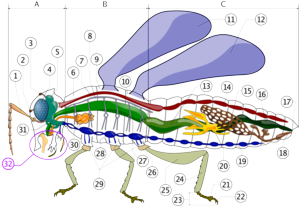
Insects range in size from less than a millimeter to over 18 centimeters (some walkingsticks) in length. Insects possess segmented bodies supported by an exoskeleton, a hard outer covering made mostly of chitin. The body is divided into a head, a thorax, and an abdomen. The head supports a pair of sensory antennae, a pair of compound eyes, and a mouth. The thorax has six legs (one pair per segment) and wings (if present in the species). The abdomen has excretory and reproductive structures.
Insects have a complete digestive system. That is, their digestive system consists basically of a tube that runs from mouth to anus, contrasting with the incomplete digestive systems found in many simpler invertebrates. The excretory system consists of Malpighian tubules for the removal of nitrogenous wastes and the hindgut for osmoregulation. At the end of the hindgut, insects are able to reabsorb water along with potassium and sodium ions. Therefore, insects don't usually excrete water with their feces, a fact which allows them to store water in the body. This process of reabsorption enables them to withstand hot, dry environments.
Read more at Wikipedia.org





 Home
Home Insects, Grubs


