Composting
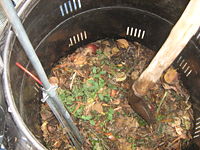
Composting is the aerobic decomposition of biodegradable organic matter, producing compost. (Or in a simpler form: Composting is the decaying of food, mostly vegetables or manure. more...
) The decomposition is performed primarily by facultative and obligate aerobic bacteria, yeasts and fungi, helped in the cooler initial and ending phases by a number of larger organisms, such as ils, and other families representing ants, nematodes and oligochaete worms.
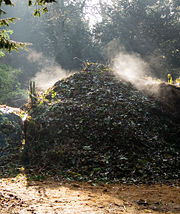
Composting can be divided into home composting and industrial composting. Essentially the same biological processes are involved in both scales of composting, however techniques and different factors must be taken into account.
Importance
Composting recycles or "downcycles" organic household and yard waste and manures into an extremely useful humus-like, soil end-product called compost. Examples are fruits, vegetables and yard clippings. Ultimately this permits the return of needed organic matter and nutrients into the foodchain and reduces the amount of "green" waste going into landfills. Composting is widely believed to speed up the natural process of decomposition appreciably as a result of the raised temperatures that often accompany it. The elevated heat results from exothermic processes, and the heat in turn reduces the generational time of microorganisms and thereby speeds the energy and nutrient exchanges taking place. It is a very popular misnomer that composting is a "controlled" process; if the right environmental circumstances are present the process virtually runs itself. Hence a popular expression, "compost happens". It is nonetheless very necessary to provide as optimal circumstances as possible for large amounts of organic waste to break down properly. This is especially so when it is accompanied by heating, since at elevated temperatures oxygen within the piles is consumed more rapidly, and if not controlled, will lead to malodor.
Decomposition similar to composting occurs throughout nature as garbage dissolves in the absence of all the conditions that modern composters talk about; however, the process can be slow. For example, in the forest bark, wood and leaves break down into humus over 3-7 years. In restricted environments, for example, vegetables in a plastic trash container, decomposition with a lack of air encourages growth of anaerobic microbes, which produce disagreeable odors. Another form of degradation practiced deliberately in absence of oxygen is called anaerobic digestion- an increasingly popular companion to composting as it enables capture of residual energy in the form of biogas, whereas composting releases the majority of bound carbon-energy as excess heat (which helps sanitize the material) as well as copious amounts of biogenic CO2 to the atmosphere.
Read more at Wikipedia.org



 Contact
 Home
Home Children's Gardening Items
 Aerators
 Bonsai Tree