Tulip
In the lily family, Liliaceae. They are bulbous plants, with large, showy flowers with six petals. There are around 100 species, originating from the region from southern Europe, north Africa, and Asia from Anatolia and Iran east as far as northeast China and Japan. more...
The centre of diversity of the genus is in the Pamir and Hindu Kush mountains and the steppes of Kazakhstan.
Use and history
The tulip is the national flower of Iran and Turkey, and tulip motifs feature prominently in Persian and Turkish folk arts. The European name for the flower is a misuse of the Persian word for turban, a mistake probably originating in the common Turkish custom of wearing flowers in the folds of the turban.
Unofficially, the flower is also emblematic of Netherlands. For instance, in an annual gesture of gratitude to Canada for liberating the nation from Nazi German tyranny in World War II, a supply of tulips is sent to be planted in Canada's national capital in Ottawa.
In both the Ottoman Empire and Netherlands, separate episodes of tulip mania struck both countries which both led to damaging speculation crashes which also contributed to the Ottoman Empire's financial decline.
Numerous cultivars have been bred for garden use. It is often considered one of humanity's "canonical flowers", along with the rose, lily, orchid, and peony (see Pollan).
Cultivation
Tulips cannot be grown in the open in tropical climates, as they require a cold winter season to grow successfully. Manipulation of the tulip's growing temperature can, however, allow growers to "force" tulips to flower earlier than they normally would.
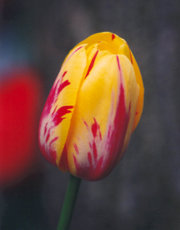
Some historical cultivars have had a striped, "feathered", "flamed", or variegated flower, as in the illustration. While some modern varieties also display multicolored patterns, this results from a natural change in the upper and lower layers of pigment in the tulip flower. Historical variegated varieties- such as those admired in the Dutch tulipomania gained their delicately feathered patterns from a viral infection. The mosaic virus is carried by peach potato aphids, Myzus persicae, an insect common in European gardens of the seventeenth century, in which peach trees were often a prominent feature. While the virus produces fantastically beautiful flowers, it also causes the plant to sicken and die slowly. Today, it has been almost completely eradicated from growers' fields. The Black Tulip was the title of a historical romance by Alexandre Dumas (1850), in which the city of Haarlem has a reward outstanding for the first grower who can produce a truly black tulip. This fascination with growing a black tulip, a task biologically impossible, was historically accurate to the tulipomania in which the novel is set.
Tulips can be grown in either of two ways: through offsets or seed. Being genetic clones of the parent plant, offsets are the only way to enlarge the stock of a given tulip cultivar. By contrast, tulips do not come true from seed; the mixing of genes between parent tulips is very unpredictable. A tulip grown from seed will usually bear only a passing resemblance to the flower from which the seeds were taken. This makes for great potential in breeding new tulip flowers, and great variation in the wild. However, tulip growers must be patient: offsets often take at least a year to grow to sufficient size to flower, and a tulip grown from seed will not flower for anywhere between five and seven years after planting. "Broken" tulips (tulips affected by the mosaic virus) will occasionally revert to plain "breeder" coloring, but usually maintain their colorful, infected state when grown from offsets.
Read more at Wikipedia.org






 Contact
 Home
Home Aquatic Plants
 Amaryllis