Tomatoes
The tomato (Solanum lycopersicum) is a plant in the Solanaceae or nightshade family, native to Central and South America, from Mexico to Peru. more...
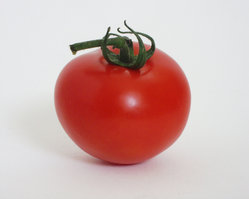
It is a short-lived perennial plant, grown as an annual plant, typically growing to 1-3 m tall, with a weakly woody stem that usually scrambles over other plants. The leaves are 10-25 cm long, pinnate, with 5-9 leaflets, each leaflet up to 8 cm long, with a serrated margin; both the stem and leaves are densely glandular-hairy. The flowers are 1-2 cm across, yellow, with five pointed lobes on the corolla; they are borne in a cyme of 3-12 together. The fruit is an edible, brightly colored (usually red, from the pigment lycopene) berry, 1-2 cm diameter in wild plants, commonly much larger in cultivated forms.
The word tomato derives from a word in the Nahuatl language, tomatl (IPA /tɔ.matɬ/).
History and distribution
Early history
According to Andrew F. Smith's The Tomato in America, the tomato probably originated in the highlands on the west coast of South America. Smith notes that there is no evidence that the tomato was cultivated or even eaten before the Spanish arrived. Other researchers, however, have pointed out that this is not conclusive, as many other fruits in continuous cultivation in Peru are not present in the very limited historical record. Much horticultural knowledge was lost after the arrival of Europeans, as the Roman Catholic Church had a policy of burning pre-Columbian information as pagan.
In any case, by some means the tomato migrated to Central America. Maya and other peoples in the region used the fruit in their cooking, and it was being cultivated in southern Mexico, and probably in other areas, by the sixteenth century. The large, lumpy tomato, a mutation from a smoother, smaller fruit, originated and was encouraged in Central America. Smith states that this variant is the direct ancestor of some modern cultivated tomatoes.
Spanish distribution
After the Spanish conquest of South America, the Spanish distributed the tomato throughout their colonies in the Caribbean. They also brought it to the Philippines, from which point it moved to southeast Asia and then the entire Asian continent.
The Spanish also brought the tomato to Europe. It grew easily in Mediterranean climates, and cultivation began in the 1540s. It was probably eaten shortly after it was introduced, though it was certainly being used as food by the early 1600s in Spain. The earliest discovered cookbook with tomato recipes was published in Naples in 1692, though the author had apparently obtained these recipes from Spanish sources.
Tomatoes in Italy
Because the plant was clearly similar to its nightshade congeners, it was assumed for years to be poisonous in Italy, where it was grown as a decorative plant. Eventually the peasant classes discovered that it could be eaten when more desirable food was scarce. This eventually developed into a whole cuisine of tomato dishes, as the wonders of the fruit became obvious. But this took several centuries, wide acceptance not happening until the 18th century.
Read more at Wikipedia.org







 Contact
 Home
Home Aquatic Plants
 Plants, Seedlings
 Berries