Lily
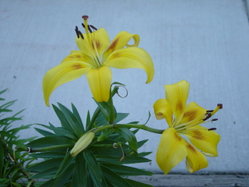
The showy and large flowered plants of the genus Lilium are the true lily plants. They are important as garden plants, and in literature. more...
Botany
They are placed in the lily family, the Liliaceae. A few species formerly included within this genus have now been placed in other genera. These include Cardiocrinum and Nomocharis.
Lilies are usually erect leafy stemmed herbs. The majority of species form naked or tunic-less scaly underground bulbs from which they overwinter. In some North American species the base of the bulb develops into rhizomes, on which numerous small bulbs are found. Some species develop stolons. A few species form bulbs at or near the soil surface.
Many species form stem-roots. With these, the bulb grows naturally at some depth in the soil, and each year the new stem puts out adventitious roots above the bulb as it emerges from the soil. These roots are in addition to the basal roots that develop at the base of the bulb.
The large showy flowers are six-petalled, often fragrant, and come in a range of colours ranging through whites, yellows and reds, sometimes with other markings.
The plants are summer flowering. Most species are deciduous, but Lilium candidum bears a basal rosette of leaves for much of the year. Flowers are formed at the top of a single erect stem, with leaves being borne at intervals up the stem.
Lilies are used as food plants by the larvae of some Lepidoptera species including The Dun-bar.
Range
Lilies are native to the northern temperate regions. Their range in the Old World extends across much of Europe, the north Mediterranean, across most of Asia to Japan, south to the Nilgiri mountains in India, and south to the Philippines. In the New World they extend from southern Canada through much of the United States.
Lilies are commonly adapted to either woodland habitats, often montane, or sometimes to grassland habitats. A few can survive in marshland and a single one is known to live as an epiphyte (L. arboricola). In general they prefer moderately acidic or lime-free soils.
Uses
Many species are widely grown in the garden in temperate and sub-tropical regions. Sometimes they may also be grown as potted plants. A large number of ornamental hybrids have been developed. They can be used in herbaceous borders, woodland and shrub plantings, and as a patio plant.
Some lilies, especially Lilium longiflorum, as well as a few other hybrids, form important cut flower crops. These tend to be forced for particular markets; for instance, Lilium longiflorum for the Easter trade, when it may be called the Easter lily.
Lilium bulbs are starchy and edible as root vegetables, although bulbs of some species may be very bitter. The non-bitter bulbs of L. lancifolium, L. pumilum, and especially L. brownii are grown at large scale in China as a luxury or health food, most often sold in dry form. They are eaten especially in the summer, for their ability to reduce internal heat. They may be reconstituted and stir-fried, grated and used to thicken soup, or processed to extract starch. Their texture and taste draw comparison with the potato, although the individual bulb scales are much smaller.
Read more at Wikipedia.org



 Contact
 Home
Home Aquatic Plants
 Amaryllis