Carrot
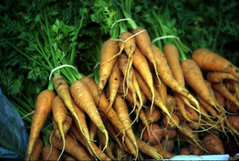
The carrot is a root vegetable, typically orange or white in colour with a woody texture. The edible part of a carrot is a taproot. more...
Uses
Carrots can be eaten raw, whole, chopped or shaved into salads for colour, and are also often chopped and cooked in soups and stews. A well known dish is Carrots Julienne. One can also make carrot cake and carrot pudding. The greens are edible as a leaf vegetable, but are rarely eaten. Together with onion and celery, carrots are one of the primary vegetables used in a mirepoix to make various broths.
Since the late 1980s, baby carrots or mini carrots, carrots that have been chopped and peeled into uniform 5 cm (2 inch) cylinders, have been a popular ready-to-eat snack food in many supermarkets.
Beta carotene, a dimer of Vitamin A, is abundant in the carrot and gives this vegetable its characteristic orange colour. Furthermore, carrots are rich in dietary fiber, antioxidants, and minerals and are an alkaline food.
Carrot juice is also widely marketed.
History
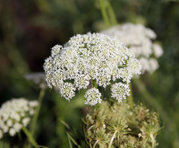
The wild ancestors of the carrot are likely to have come from Afghanistan which remains the centre of diversity of D. carota. The familiar wild plant wild carrot, often called "Queen Anne's lace", is a relative of the garden carrot; garden carrots that run to seed soon revert to their wild prototype, with a forking carroty-smelling, edible root that quickly becomes too woody and bitter to eat. The Parsnip is a close relative of the carrot.
Cultivars
Carrot cultivars can be grouped into two broad classes, eastern carrots and western carrots.
Eastern carrots
Eastern carrots were domesticated in Central Asia, probably in modern-day Afghanistan in the 10th century or possibly earlier. Those of the eastern carrot that survive to the present day are commonly purple or yellow in colour, and often have branched roots. The purple colour common in these carrots comes from anthocyanin pigments.
Western carrots
The Western carrot emerged in the Netherlands in the 15th or 16th century, its orange colour making it popular in those countries as an emblem of the House of Orange and the struggle for Dutch independence. The orange colour results from abundant carotenes in these cultivars. While orange carrots are nearly ubiquitous in the West, other colours do exist, including white, yellow, red, and purple. These other colours of carrot are raised primarily as novelty crops.
The Vegetable Improvement Center at Texas A&M University has developed a purple-skinned, orange-fleshed carrot, the BetaSweet, with substances to prevent cancer, which has recently entered commercial distribution.
Western carrot cultivars are commonly classified by their root shape:
Read more at Wikipedia.org




 Contact
 Home
Home Aquatic Plants
 Plants, Seedlings
 Berries